


In 1964, The Rolling Stones released the hit single, "Time Is on My Side." Who knew they were talking about personal finance? What does it mean to put time on your side? To The Rolling Stones, it was a song about confidence and patience with love. To investors, it's about confidence and patience when investing for long-term goals, such as retirement.
As a young investor, you have a powerful ally on your side: time. The earlier you start saving, the more opportunity your investments have to increase in value.
Many people underestimate the power of compounding, so it is worth illustrating. Let's take a look at the long-term performance of an investment account using a hypothetical 5 percent rate of return.
How does it work?
A simplified example goes like this: If you contribute $1,000 at the start of each year to an account earning 5 percent annually, you would end up with $69,761 after thirty years: $30,000 in contributions, $23,250 in interest on those contributions, and $16,511 in compound interest — interest earned on your interest. That last slice is the snowball, and it keeps growing even if you stop making deposits.1
The 30-Year Snowball Effect
$1,000/year · 5% annual return · No starting balance
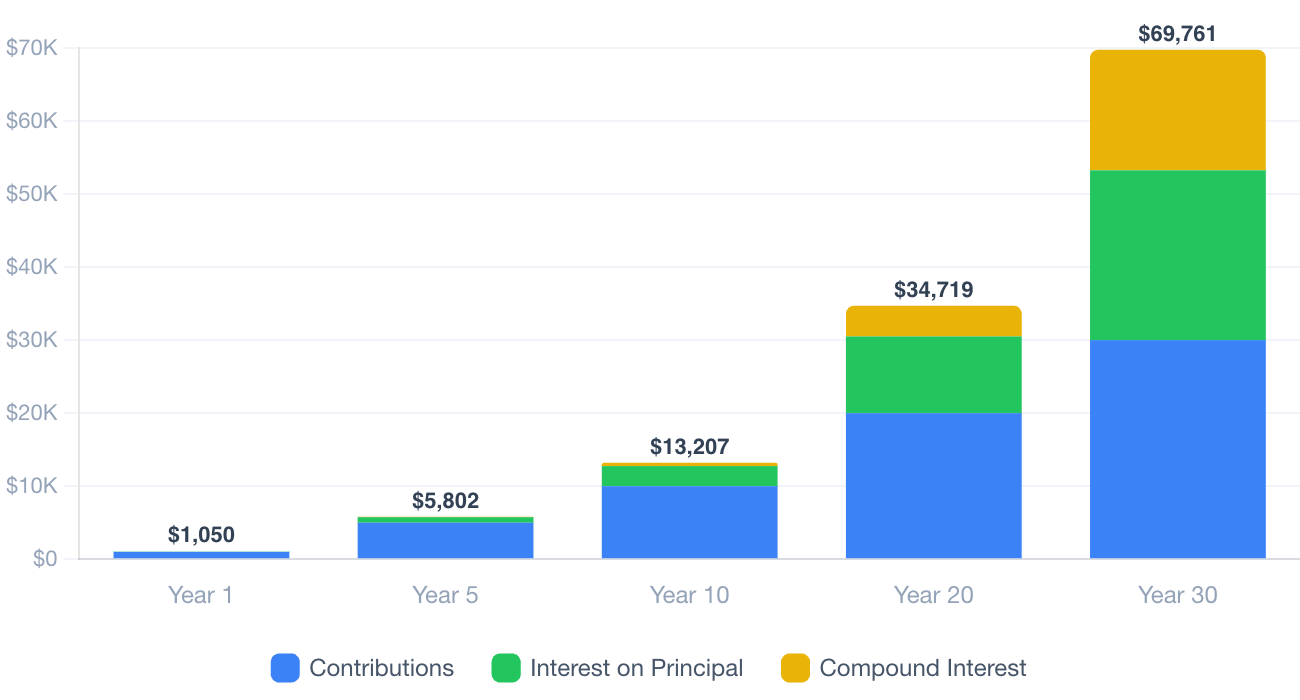
The Power of Starting Early: Let Time Do the Heavy Lifting
When it comes to building wealth, most people focus on how much they can save and the kinds of returns they can earn. While those are important, there is a third factor that is often much more powerful: Time.
The math of compound interest rewards those who start early, even if they save less in total than someone who starts later. To illustrate this, let's look at two hypothetical investors:1
The Early Starter
Contributes $10,000 a year for just 10 years, then stops entirely.
Total Contributed: $100,000
Ending Balance: $850,608
The Late Starter
Waits 10 years, then contributes $10,000 a year for 30 years straight.
Total Contributed: $300,000
Ending Balance: $888,298
Investor Balance Over Time
Hypothetical 6% annual rate of return
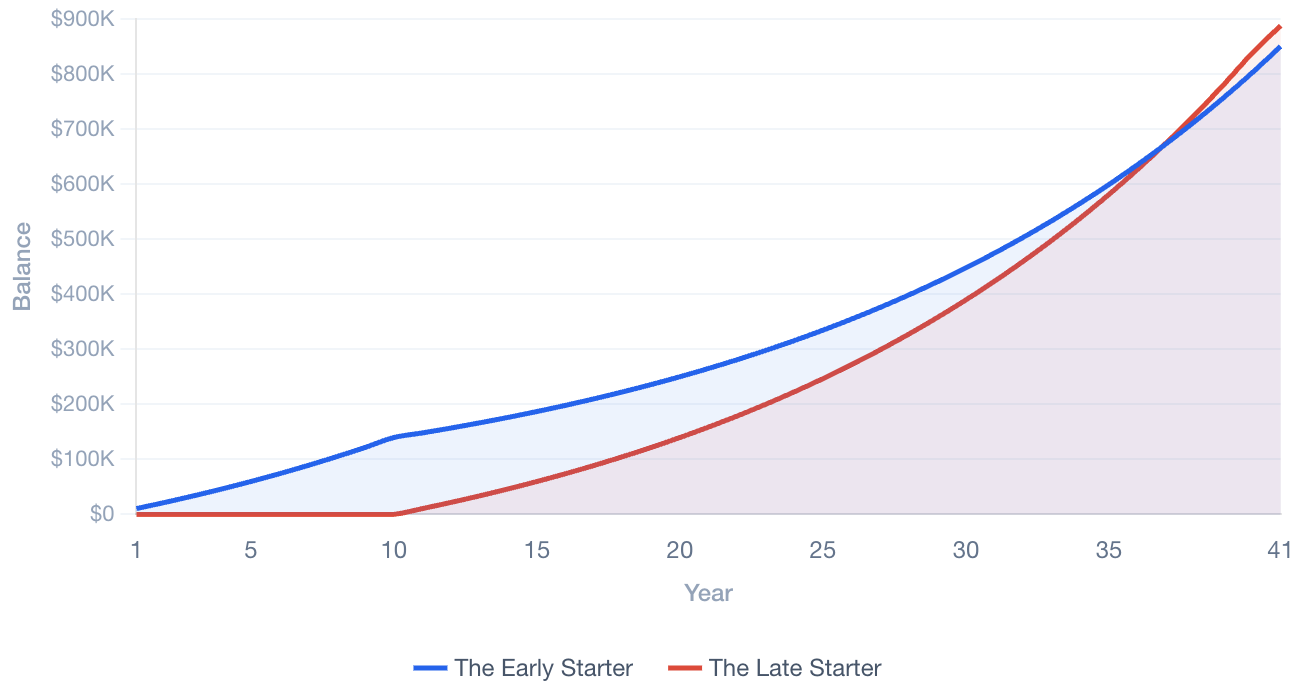
The visualization above highlights a startling reality of the financial world: effort does not always equal results. Investor 1 put in a total of $100,000 over a single decade and then let the market do the rest. Meanwhile, Investor 2 contributed $300,000—three times as much capital—over 30 years.
As you can see from the trajectories, Investor 2 spends their entire career playing "catch-up." Even though their total balance eventually edges out Investor 1 by a small margin at age 62 ($888,298 vs $850,608), the "efficiency" of their money is far lower. Investor 1 essentially bought themselves a 30-year head start, proving that in the world of compounding, a small amount of money plus a long time is often superior to a large amount of money plus a short time.
Footnotes & Sources
- This is a hypothetical example used for illustrative purposes only. It is not representative of any specific investment or combination of investments.